You
Can Make Them Faster!
One of the
biggest mistakes we coaches often make is not spending
enough time on speed development. Perhaps when we
recognize that not everyone is blessed with Thierry
Henry or Landon Donovan speed we feel our time is
better spent on skill development.
We don’t
disagree that we all have different potentials but
we believe that few of us truly come close to reaching
our potential and that there’s ample room
for speed improvement in most players especially
in their acceleration, stop and start and decision
making speed.
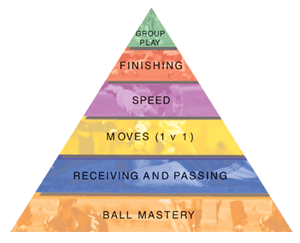
At Coerver we try to incorporate all of these speeds
in as many of our exercises and games as we can.
Truly skillful players do all the right things…stop
and start, fake and feint, give and go……all
the time and do them at speed.
As coaches we can help our players develop these
speeds in several ways.
-
Speed
of Foot
– While
science tells us we are each born with
more or less fast twitch fibres that
determine the limits of our speed our
experience is that most players are
playing no where near their limit. We
must develop fun drills and exercises
to encourage our players to compete
and get faster and fitter.
-
Reaction
Speed
- Every club has a player who is deceptively
fast. Wayne Rooney of Manchester United
and England is such a player. To be
sure he has excellent straight ahead
speed. But what makes him so lethal
is his acceleration and ability to hit
maximum speed within just a couple of
strides. It’s this kind of speed
that enables him to pounces on opponent’s
mistakes and invariably finish brilliantly.
Acceleration, stop and start and change
direction speeds are vital attacking
qualities and we should be making every
effort to develop them in every training
session.
-
Decision Making Speed
– In Coerver Coaching all of
our full pressure small sided games
and exercises are perfectly suited
for this kind of speed development.
There is nothing more valuable we
can do for our players than to help
them develop the ability to assess
situations and make good decisions
under full game pressure. This is
our task and we shouldn’t avoid
it.
|
Speed
Practice…It Can Be Fun!
We
can’t talk about speed development without
discussing fitness. Obesity is a nationwide epidemic.
One of our jobs as soccer coaches has to be to
motivate our players to get and keep fit. An essential
part of this is having fun while training. Players
who enjoy practice will keep at it longer and
improve quicker not to mention get in shape.
We try to incorporate speed in as many of our
drills as possible to provide variety and motivation.
The speed drills we have for your review today
we use all the time in our camps and clinics.
It helps build fitness and stamina and develops
reaction time and decision making speed. Let’s
check it out.
Watch
the video closely to see the correct form.
The text below should help you with the set up for
the four speed drills reviewed in the video. Watch
it a couple of times make sure you got them down.
Exercise 8
Setup
6- by 30 yard lanes
with “end zones” marked as shown.
Two players with one
ball at one end of each lane and a third player
with the ball at the other end.
Action
The single player
dribbles the ball toward the opposite player.
When the dribbler
is within three or four yards of the opposite player,
he passes to him.
The receiving player
must then dribble with speed to the opposite end
line while the passing player must run backward
and try to get there first.
If this is too easy
for the receivers, change the drill so that the
passer can turn and sprint to the end line.
Note:
The dribbler must have full control of the ball
upon reaching the end line and the sprinter should
not interfere with the dribbler’s run.
Tips
The single player
always begins plays with the ball.
Passing players must
make easy passes so receiving players can take the
ball without having to stop it or chase it.
Dribblers must keep
control of the ball when running. (The ball must
always be within three feet of the dribbler.)
Exercise
9
Setup
6- by 20-yard lanes.
Two players at the
beginning of each lane.
One ball for each
pair.
Action
The player with the
ball chooses his moment to sprint with the ball
to the opposite end of the lane while his or her
partner tries to beat him there.
As soon as the ball
is touched, the game is live. The player without
the ball shouldn’t try to tackle, impede or
win the ball.
Then players exchange
roles and repeat the action in the opposite direction.
Tips
Encourage players
to be creative in all competitions. In this exercise,
suggest they gain advantage by faking the first
touch.
Start with 10-yards
sprints.
Exercise 10
Setup
10- by 25-yard lanes.
Two players per lane.
Give one player in
each lane a ball.
Action
One player passes
to his partner, overlaps and tries to beat him to
the opposite end of the land. The overlapping partner
shouldn’t try to tackle, impede or win the
ball.
At the end line, players
change roles and repeat the exercise.
Tips
Encourage players
to look up as much as possible when running with
the ball.
Advice the player
without the ball to use his/her arms to power him
her forward.
Exercise
11
Setup
A 20- to 30-yard area.
Two goals two yards
wide at one end.
Players in four groups
of up to five players each. Each group forms a line,
with two groups on each side of the coach.
The two lines closest
to the coach (B and C) are attackers; the two groups
farthest from the coach are defenders (A and D).
The coach has a supply
of balls.
Action
The coach plays a
ball to the front player of one of the two attacking
line (B or C).
The receiving player
tries to dribble at speed through either of the
end goals while the front player from the closest
defending line tries to win the ball. The defender
can score upon winning the ball.
The coach starts the
sequence each time the ball is out of play or the
defender wins the ball. |