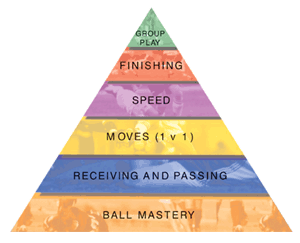
First
Touch…Practice Will Make Perfect.
Welcome to
lesson two of our Six Steps To Success Program.
Today we focus on the next key foundational skill
of first touch and its importance in receiving and
passing.
Soccer is a fast paced game with players constantly
competing for control and possession of the ball
and time and space to make the most effective use
of it. Often the key determining factors in how
well players receive and control is how quickly
and accurately the ball is delivered to them by
their team mate. Great passers like David Beckham,
Zinedine Zidane and Kristine Lilly make it look
effortless as they receive and deliver balls that
make it easy for team mates around them. Their precise
touches often lead to exciting shots and goals that
determine some of the world’s most famous
Cup games and League Championships.
These sublime skills are of
course the result of countless hours of practice.
The stars, aware of the importance of these abilities,
will continue to refine their passing and receiving
skills throughout their career. At Coerver Coaching
we have some excellent drills for small groups
that can quickly improve this critical part of
every players game. You are never too young or
too old for these drills. Try them. They will
improve your game.
Watching Great Players
Helps
We always recommend at our camps
and clinics that players watch games whenever
they get the chance. Now thanks to Fox Sports
and cable we can see more world class soccer than
ever before whether it is the MLS, Premiership,
Italian, French, Spanish and South American league
play or European and World Cup games. The world
famous teams and star players in these games are
models of some of the best skills in the game
and we encourage you and your players to watch
as much of them as possible. Ask your players
to identify the key players and the individual
skills and actions that make them so effective.
Then use the stars as your model to make the action
yours and your player’s. We think this is
a great way to motivate young players and expand
their soccer knowledge and skills. So Dream, Believe
and Achieve. You Can Do It!
Okay now let’s get to
the set of drills we want to work with to improve
your first touch.
Notice in the video how the players use both feet.
Two footedness is a key ability and one we stress
at in all of our Coerver? drills. Watch these
drills and emulate the plays. Not only will your
receiving and passing improve but you will develop
more confidence with both feet.
Watch
the video closely to see the correct form.
The text below should
help you with the set up to the drills 1- 4 we cover
in the video. Again while these drills can be done
at a formal practice, they could also be done in
a backyard with a sister, brother, mother, father
or friend. filling in if teammates are unavailable.
These drills often are a good warm-up as well. It
gets the players running handling the ball and keeping
their head up…all good for the developing
player.
Video Drill
Exercise 1
Setup
A 10- by 10- yards area.
Group of three players.
One ball to each group.
Two players with the ball are positioned
on one side of the square.
The third player faces them on the
other side.
Action
The player with the ball passes to
the third player on the opposite lane who receives
with the inside of the foot and takes the ball a
couple of yards to the side in one action.
On his next touch he passes the ball
back across the square with his other foot.
The pair opposite switch places and
repeat the action.
Tips
Remind players that it’s important
to give a good pass so it is easier for their teammates
to receive the ball and control it away with their
first touch.
Allow two touches to start before
limiting players to one touch.
Remind the receiving player to move
toward the ball.
Exercise 2
Setup
A 10- by 10- yards area.
Players in groups of three with a
ball to each group.
Two players with the ball on one side
of the square face the third player on the opposite
side.
Action
The first player passes to the opposite
player and sprints around him/her.
The receiving player taps the ball
to the side, first touch, as the sprinting player
comes around him/her. The sprinting player passes
first touch to the next player facing him/her who
repeats the action.
The end player changes after several
sequences.
Tips
Receiving players can start with two
touches to make the pass. Once this becomes easy,
limit players to one- touch passes.
Exercise 3
Set up
A 10-by 10-yard to 15-by 15-yard area.
Groups of up to four players at each corner.
One group starts with a ball.
Action
Players pass counterclockwise to the
first player in the next group and follow their
passes.
The receiving player taps the ball
softly by the incoming passer, runs around him to
the ball and passes to the first player in the next
group.
Tips
Have players cushion the impact of
a received ball by drawing back their foot as the
ball arrives.
Remind receiving players to move to
the ball.
To increase difficulty, introduce
another ball. Have two groups diagonally across
from one another start with balls.
Exercise 4
Set up
A 10-by 10-yard area
Two small 2-yard gates on either side
of the square as shown.
Two passers, each with a ball, at
opposite corners and facing their respective gates.
Two receivers in the gates.
Action
The passers pass to their receivers.
Receivers take the ball to the opposite
side of the square with their first touch and pass
to the next corner player.
The receiver then returns to his/her
first gate to receive the next pass from a corner
player and the sequence continues.
Passers and receivers switch after
eight repetitions.
Tips
Allow players three touches at first:
one to receive, one to turn and one to pass. After
players are comfortable, tell them to try turning
with the ball on their first touch.
A good first touch gives a player
more time and space during a game.
Receiving players should try
to play the ball in the direction they want to go
– without stopping the ball.
|